
What Is GEO? The Future of GEO in 2026 Something big just happened — and most small business owners in the USA have no idea.
Google might still be hitting that massive 5 billion daily search mark, but the way we use search has fundamentally shifted. Look at the numbers: ChatGPT is already processing over 858 million queries every single month. When you add in the millions of questions being answered by Perplexity, Microsoft Copilot, and Google’s own AI Mode, the picture becomes clear. These AI tools aren’t just helping us search—they’ve changed the game entirely. They don’t just dump a list of links on you; they process the information and give you the answer directly. It’s a total shift from ‘finding’ an answer to just ‘getting’ one.
Here is the scary reality: if your brand isn’t being cited in those AI-generated answers, you’re essentially invisible to a massive, emerging group of customers. It doesn’t mean your SEO strategy is failing; it just means the game has evolved. Relying on traditional SEO isn’t enough anymore because the way people get their information has changed—and you need to adapt if you want to stay in the conversation. What Is GEO? The Future of GEO in 2026
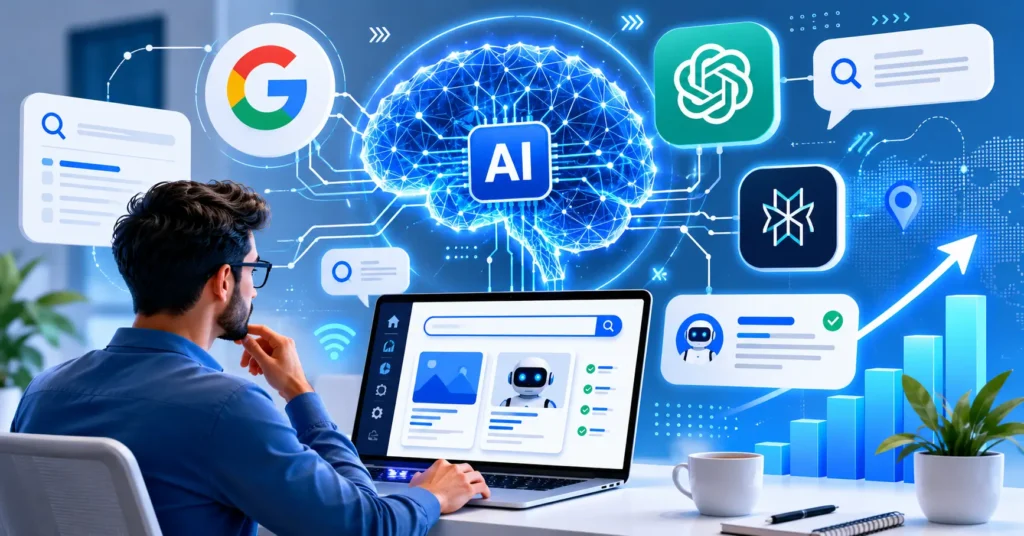
Welcome to the era of GEO — What Is GEO (Generative Engine Optimization)? 2026
If that term feels brand new, don’t worry—you’re exactly where you need to be. Stick with me through this post, because by the time we finish, you’ll not only understand what it means, but you’ll see exactly why it’s the missing piece of your growth strategy. More importantly, I’m going to walk you through the practical steps you can start taking today to make sure your brand is the one the AI chooses to trust. What Is GEO? The Future of GEO in 2026
What Is Generative Engine Optimization (GEO)?
GEO is the practice of optimizing your content so that AI-powered search engines — like ChatGPT, Google AI Overviews, Perplexity, and Bing Copilot — actually reference your business, your content, or your expertise when answering user questions.
Traditional SEO gets you ranked on Google’s blue-link results page. GEO gets you cited inside the AI answer itself.
Think about the difference. When someone searches “best digital marketing agency for small businesses,” old-school SEO puts your website on page one. GEO makes your business the one ChatGPT recommends by name when someone asks the same question out loud to their phone or AI assistant.
That’s not the future. That’s happening right now — in June 2026. What Is GEO (Generative Engine Optimization)? 2026
At DIGI EXPERT HUB, we’ve been watching this shift unfold in real time. And what we’re seeing is that the businesses moving early on GEO are building an enormous advantage over competitors who are still focused only on keyword rankings.
Why GEO Matters More Than Ever in 2026
The AI Search Revolution Is Already Here
Here’s what the numbers look like right now: What is GEO (Generative Engine Optimization)?
- Google — 5 billion users, 77.9% of digital queries
- ChatGPT — 858 million users, 17.1% of queries
- Bing, Perplexity, others — 5% of queries
That 17% ChatGPT number? It was essentially zero two years ago. It’s growing every single month. And Google itself has responded by launching AI Overviews — which answer questions directly at the top of search results, before any website links appear.
This means the traffic that used to flow to websites is now being intercepted by AI answers. Gartner predicted that traditional search volume would drop 25% by 2026. We’re living that prediction right now.
Zero-Click Searches Are Killing Old SEO
You’ve probably noticed this yourself. You search for something on Google, read the answer at the top of the page, and never click on a single website. That’s a zero-click search.
For businesses that built their entire online presence around ranking on page one of Google, zero-click searches are devastating. All that work, all those backlinks, all that content — and nobody visits the actual website anymore.
GEO is the solution. Because when the AI answer references your business or cites your content, your brand gets mentioned directly to the person asking — without them needing to click anything. That’s brand visibility in the AI era. What Is GEO (Generative Engine Optimization)? 2026
GEO vs SEO — What’s the Difference?
A lot of people ask this, so let’s make it simple:
Traditional SEO optimizes your content so Google’s algorithm ranks your page highly in search results.
GEO optimizes your content so AI systems understand, trust, and reference your expertise when generating answers for users.
They’re not opposites. In fact, good SEO still helps with GEO. But GEO requires some additional thinking that most businesses haven’t started yet.
Here’s the key difference: Google’s algorithm ranks pages. AI models synthesize information and choose which sources to trust. To show up in AI answers, you need to be seen as a credible, authoritative, easy-to-understand source — not just a keyword-optimized page.
5 GEO Strategies That Actually Work in 2026
1. Write in a Question-and-Answer Format
AI models love content that directly answers questions. The reason is simple — AI is built to answer questions, so it naturally reaches for content that’s already structured that way.
Instead of writing: “Our social media marketing services help businesses grow their online presence through strategic content creation and audience targeting…”
Write: “What does a social media marketing agency actually do? A good agency handles content creation, posting schedules, audience research, and performance tracking — so business owners can focus on running their business instead of worrying about Instagram.”
One of those sounds like a brochure. The other sounds like something an AI would actually cite.
2. Build Topical Authority — Not Just Individual Pages
AI systems don’t just look at one page on your website. They look at your entire online presence to decide if you’re a real authority on a topic.
That means you need to cover your core topic — SEO, social media marketing, digital strategy — from multiple angles. Blog posts, FAQs, how-to guides, case studies, service pages. The more thoroughly you cover a subject, the more AI systems trust that you actually know what you’re talking about.
This is something the team at DIGI EXPERT HUB helps clients build systematically — a content ecosystem that positions them as the go-to authority in their niche, not just a business with a website. What Is GEO (Generative Engine Optimization)? 2026
3. Get Mentioned on Other Credible Websites
This one hasn’t changed from old-school SEO — but it matters even more for GEO. AI models are trained on large amounts of internet content. If your business is consistently mentioned, quoted, or referenced on reputable websites, podcasts, industry blogs, and news sites, AI systems are far more likely to recognize your brand as legitimate.
Reach out for guest posts. Get quoted in industry articles. Ask satisfied clients to mention your business in their own content. Every credible mention is a signal to AI that your business is real and trustworthy.
4. Use Structured Data and Schema Markup
What Is GEO (Generative Engine Optimization)? Schema markup is code you add to your website that helps both Google and AI systems understand exactly what your content is about. It’s been important for SEO for years — but in 2026, it’s become critical for GEO.
Make sure your website has proper schema for your business type, your services, your FAQs, and your reviews. If this sounds technical, it’s something any good digital marketing agency can set up for you in a few hours. It’s one of the highest-ROI things you can do for your online visibility right now.
5. Make Your Content Easy for Machines to Read
AI systems parse content differently from how humans read it. Clear headings, short paragraphs, direct sentences, and a well-organized structure all make it easier for AI to extract and reference your content accurately. What Is GEO (Generative Engine Optimization)?
Avoid walls of text. Use subheadings generously. Define your terms. Answer the obvious questions your customers would ask. Write like you’re explaining something to a smart friend — not performing for a search algorithm.
How to Start With GEO Today (Even on a Small Budget)
You don’t need to throw out your current SEO strategy. Think of GEO as a layer you add on top. Here’s where to start:
Audit your existing content. Does it answer real questions directly? Is it easy to read? Does it establish your expertise clearly? If not — rewrite it.
Add an FAQ section to every page. FAQs are goldmines for AI citation. Structure them with real questions your customers ask and clear, specific answers.
Claim and optimize your Google Business Profile. AI tools frequently pull business information from Google’s own data. An up-to-date, well-reviewed Google Business Profile is one of the fastest wins available. What Is GEO (Generative Engine Optimization)?
Start building mentions. Reach out to local news sites, industry blogs, and partner businesses. Ask for collaborations, guest posts, or even just a mention. Every external reference builds your AI credibility.
The Bottom Line: The Businesses That Win in 2026 Understand Both SEO and GEO
The rules of digital marketing are changing faster than most businesses can keep up with. And the gap between businesses that understand this shift and those that don’t is going to get very wide, very fast.
The good news? You don’t have to figure this out alone. At DIGI EXPERT HUB, we specialize in helping small businesses in the USA build digital strategies that work in the real world — not just on paper. That means combining proven SEO fundamentals with forward-thinking GEO strategies that keep you visible no matter how search evolves.
If you want to stop reacting to algorithm changes and start building something that actually grows your business — let’s talk.
Visit DigiExpertHub.com and book a free strategy call today.
Frequently Asked Questions About GEO
Q1: Is GEO replacing SEO completely?
No, not yet, and probably not entirely. Google still dominates search with nearly 78% of all queries. Traditional SEO still matters. But GEO is becoming essential alongside SEO, especially as AI Overviews and ChatGPT continue capturing more search traffic. The smartest businesses are doing both right now.
Q2: How do I know if AI is already mentioning my business?
Try it yourself. Go to ChatGPT or Perplexity and ask: “What are the best digital marketing agencies for small businesses in [your city]?” or “Who offers SEO services near [your location]?” If your business doesn’t appear — that’s your starting point.
Q3: How long does GEO take to show results?
It varies, but generally faster than traditional SEO for brand awareness. AI models are constantly being updated with new information from the web. Quality content, external mentions, and structured data can start influencing AI responses within weeks rather than months.
Q4: Do I need to hire an agency for GEO?
Not necessarily for the basics — the strategies above are things any business can start implementing. But if you want a comprehensive strategy, ongoing content creation, and technical optimization done correctly, working with an experienced agency saves significant time and avoids costly mistakes.
Q5: Does DIGI EXPERT HUB offer GEO services?
Yes — it’s one of the fastest-growing parts of what we do. We help small businesses audit their current content for AI readiness, build topical authority, set up proper schema markup, and develop a content strategy that performs in both traditional search and AI-powered platforms. Reach out here to learn more.