
68% of Google Searches End Without a Click. The ground beneath the search engine optimization (SEO) world just experienced a massive seismic shift. If you have noticed your website’s organic traffic behaving erratically over the last few months, you are not imagining things, and you are definitely not alone.
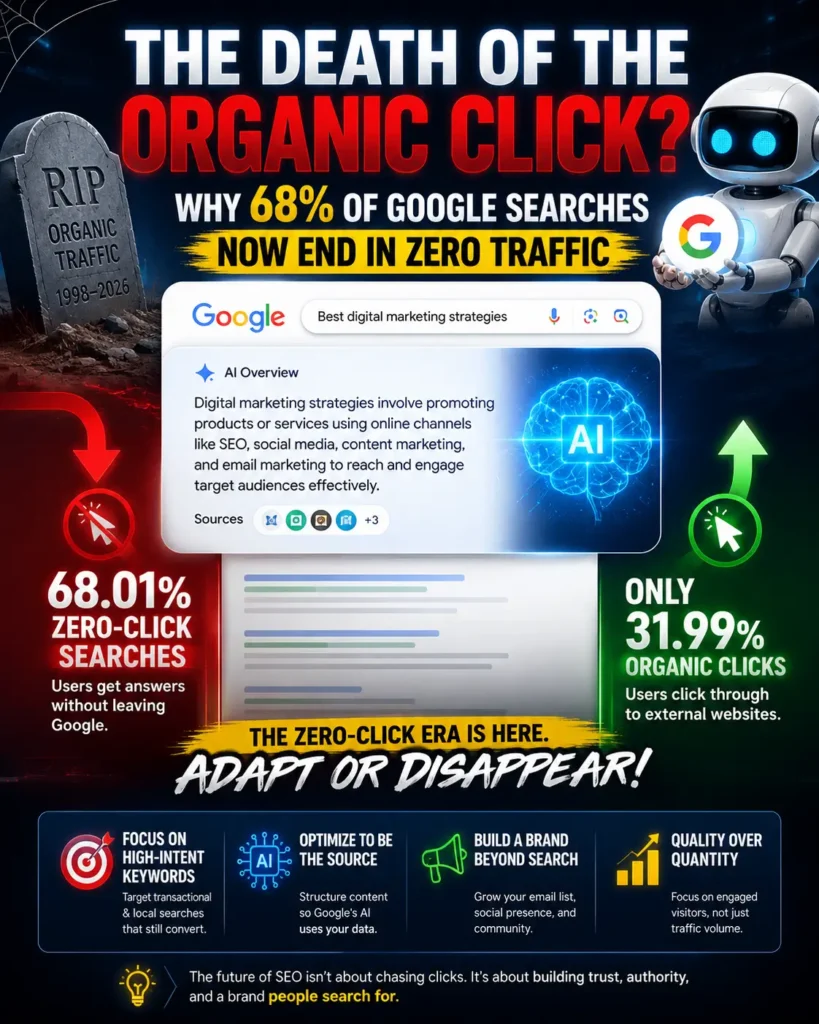
The Death of the Organic Click? Why 68% of Google Searches Now End in Zero Traffic
The ground beneath the search engine optimization (SEO) world just experienced a massive seismic shift. If you have noticed your website’s organic traffic behaving erratically over the last few months, you are not imagining things, and you are definitely not alone. 68% of Google Searches End Without a Click. 68% of Google Searches End Without a Click
According to a groundbreaking June 2026 research study published by SparkToro, using comprehensive clickstream data from Similarweb, a staggering 68.01% of all Google searches in the United States ended without a single click during the first four months of 2026. 68% of Google Searches End Without a Click
Let that sink in for a moment. Out of every 1,000 searches conducted on Google, roughly 320 users actually click through to an external, independent website. The remaining 680 users either find their answer directly on Google’s results page, modify their query to search again, or simply close the tab.
At Digi Expert Hub, we closely track the search landscape mechanics. This isn’t just another routine algorithm tweak; it represents a fundamental pivot in how the open internet operates. Let’s pull back the curtain on this data, analyze why it’s happening, and map out exactly how your brand can survive and thrive in this new “Zero-Click.”
The Hard Numbers: 68% of Google Searches Are Zero-Click
68% of Google Searches End Without a Click. To truly understand how rapidly the search ecosystem is changing, we need to compare where we were just a couple of years ago to where we stand today in 2026. Back in 2024, the percentage of zero-click searches sat at roughly 60.45%. In a span of just 24 months, that number jumped by 7.56 percentage points to reach the current historic high of 68.01%.
A Stark Decline in User Click-Through Behavior
The share of Google searches that generate at least one click (whether that click goes to an organic website link, a paid advertisement, or even a Google-owned property like YouTube or Google Maps) has plummeted by 9.51 percentage points since 2024. That represents a massive 22.9% decline in overall search-to-click efficiency for web publishers. 68% of Google Searches End Without a Click. 68% of Google Searches End Without a Click
The Loop of Continuous Search Refinement
Where are those users going if they aren’t clicking? The SparkToro study revealed a fascinating behavioral change: over the same two-year period, the percentage of searches that led directly to another consecutive Google search rose by 7.2 percentage points. 68% of Google Searches End Without a Click
Instead of leaving the ecosystem, users are staying on Google, continuously refining their queries, and feeding the search engine more data, all while independent web publishers lose out on the final traffic referral. 68% of Google Searches End Without a Click
The Culprits: AI Overviews and the Rise of “AI Mode”
Why is Google suddenly retaining the vast majority of web traffic for itself? The answer lies heavily in the rapid integration of Generative AI directly inside the Search Engine Results Pages (SERPs). 68% of Google Searches End Without a Click
How AI Overviews Code-Red Your Organic Traffic
Google’s AI Overviews have graduated from an experimental beta feature to a permanent fixture of the search experience. The data shows that AI Overviews now appear on more than 20% of all Google searches in the United States. 68% of Google Searches End Without a Click
When an AI Overview triggers at the top of the page, the impact on traditional search listings is devastating: click-through rates (CTR) drop by nearly 60%. Because Google synthesizes information from five or six different websites into a single, neat AI response at the absolute top of the screen, users get the information they need instantly. They have zero incentive to scroll down past the fold to click on your organic article link. 68% of Google Searches End Without a Clic.k
The Emerging Wildcard: Google’s AI Mode
During the study period of January to April 2026, SparkToro noted that only about 0.34% of searches shifted directly into Google’s dedicated AI Mode. At first glance, this looks like a minor, negligible fraction. 68% of Google Searches End Without a Click
However, looking at the broader picture reveals why this is a ticking time bomb for traditional traffic. At the Google I/O 2026 conference, Google officially confirmed that its AI Mode has surpassed 1 billion monthly active users, with overall query volume more than doubling every single quarter. As more users transition into an active, conversational AI dialogue window, the traditional click to a blog post or landing page will face even steeper downward pressure. 68% of Google Searches End Without a Click
A Historical Look at the Zero-Click Trend
While the jump between 2024 and 2026 feels incredibly abrupt, a historical look back reveals that Google has been building toward this closed-loop ecosystem for nearly a decade: 68% of Google Searches End Without a Click. 68% of Google Searches End Without a Click
- 2019: Early clickstream panels tracked by SparkToro showed that roughly 49% to 50.33% of searches ended without a click. This was the era of basic featured snippets and local map packs starting to dominate the screen.
- 2020: During the peak pandemic year, zero-click searches spiked sharply to 64.82% as users searched for rapid, immediate facts regarding global health guidelines and local store hours.
- 2024: The market briefly stabilized, with U.S. zero-click searches hovering around 58.5% (and 59.7% within the European Union, where stricter regulatory frameworks like the DMA protected external links).
- 2026: We have officially hit a new peak of 68.01%, heavily driven by automated AI generation answering user queries directly.
A Note on Data Rigor: It is important to remember that tracking clickstream data across multiple years is highly complex. Because historical data providers and consumer tracking panels change over time, we shouldn’t treat these percentages as perfect apples-to-apples trendlines. However, every single data set points to one undeniable reality: zero-click behavior is steadily growing, and the open web is losing its direct referral monopoly. 68% of Google Searches End Without a Click
The New Playbook: How to Build an Invisible SEO Strategy
If nearly 70% of searches don’t result in a website visit, is SEO dead? Absolutely not. But the old way of doing SEO—where you write a basic informational article, rank number three, and watch the traffic roll in—is officially insufficient. 68% of Google Searches End Without a Click.
To survive in 2026, your digital marketing framework needs to adapt to a brand-heavy, multichannel model. Here is the action plan we are implementing for our clients at Digi Expert Hub: 68% of Google Searches End Without a Click
1. Own the High-Intent and Transactional Keywords
AI Overviews are exceptional at answering top-of-funnel informational questions (e.g., “What is the history of digital marketing?”). However, AI cannot easily replicate high-intent, hyper-local, or transactional searches. Focus your keyword research on branded searches, deep local queries, and commercial long-tail keywords (e.g., “Best real estate SEO expert in Dubai”). These categories still generate massive, high-converting clicks because the user is looking to hire or buy, not just read a definition.
2. Optimize to Be the Source for Google’s AI
If Google is going to use an AI snippet to answer a question, make sure it pulls the data directly from your website. Optimize your content layout with ultra-clear headings, bulleted data tables, and highly authoritative, human-written conclusions. Even if the user doesn’t click, your brand name showing up in the AI Overview’s citation link builds massive cognitive trust.
3. Build a Brand That Transcends the Search Box
As SparkToro co-founder Rand Fishkin suggests, you must invest heavily in brand awareness outside of Google. If users already know, like, and trust Digi Expert Hub, they won’t just type a generic query into Google and settle for an AI answer. They will type your specific brand name directly into the search bar or go straight to your URL.
Diversify your audience touchpoints by building an active email newsletter, publishing natively on platforms like LinkedIn or X, and building a community where your target audience naturally hangs out.
Final Thoughts: Embracing the Future of Search
The web is evolving, and while a 68% zero-click metric looks intimidating on paper, it also filters out low-intent traffic. The visitors who do end up clicking through to your site in 2026 are highly qualified, deeply engaged, and far more likely to convert into actual paying leads.
Stop chasing vanity traffic metrics. Focus on building an unforgettable brand, nailing your technical SEO foundation, and creating human-centric content that search engines simply cannot ignore.
Frequently Asked Questions (FAQs)
What exactly is a zero-click search?
A zero-click search occurs when a user enters a query into a search engine like Google but leaves the platform without clicking on any organic search results or paid advertisements. The user’s intent is typically fully satisfied by elements directly on the SERP, such as AI Overviews, Featured Snippets, Knowledge Panels, or Local Maps.
Why are AI Overviews causing a drop in website traffic?
AI Overviews aggregate data from across the web and present a complete response at the top of the search results. Because the user reads the answer instantly without needing to click an external link, the overall click-through rate (CTR) for organic websites drops by nearly 60% on those specific queries.
Is SEO still a viable marketing channel in 2026?
Yes, SEO remains highly effective, but its core objectives have shifted. While broad informational traffic is harder to capture, high-intent transactional searches, local business queries, and branded searches continue to drive massive, high-converting organic traffic to websites.
What can digital marketers do to counter the zero-click trend?
Marketers should focus on long-tail transactional keywords, optimize content to be cited inside AI snippets, and aggressively invest in multi-channel brand awareness (such as LinkedIn, email marketing, and video content) so that audiences seek out the brand directly rather than relying solely on generic searches.
Does this data mean Google is acting unfairly toward web publishers?
The data indicates that Google is prioritizing user retention within its own platform ecosystem to serve ads and refine its AI algorithms. While this creates a challenging environment for traditional web publishers, it forces the industry to shift toward creating deeper, highly authoritative, human-centric content that automated AI summaries cannot easily replicate.