
Google Loses Its Crown: Meta Takes the Lead. For more than two decades, Google sat comfortably on the digital throne. It dominated search, online advertising, website traffic, and how billions of people discovered information online. Businesses, marketers, publishers, and content creators built entire industries around Google’s ecosystem.
But in 2026, something happened that few experts thought possible.
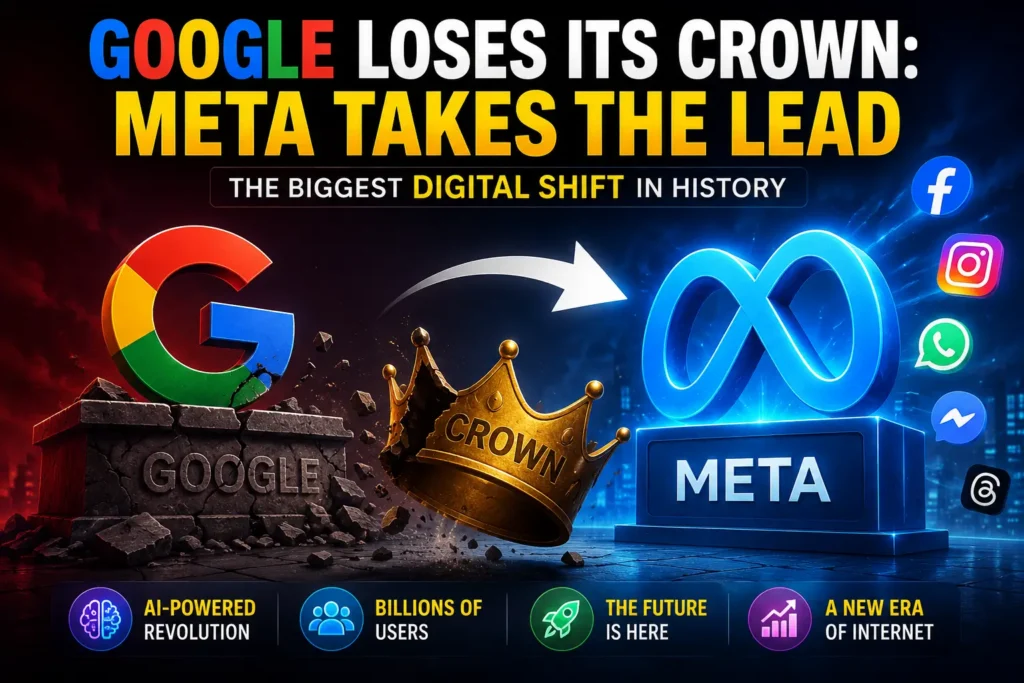
For the first time in digital history, Meta managed to outperform Google in a critical area of online attention and user engagement. While Google remains one of the most powerful technology companies in the world, the rise of artificial intelligence, changing user behavior, and Meta’s aggressive innovation strategy have shifted the balance of power. Google Loses Its Crown: Meta Takes the Lead
At Digi Experts Hub, we closely monitor digital trends, and this moment could become one of the most important turning points in the history of the internet.
The Moment Meta Surpassed Google
The digital landscape is changing faster than ever before. For years, Google controlled how users found content online. Whether someone needed information, products, services, or answers, Google Search was the default destination. Google Loses Its Crown: Meta Takes the Lead. Google Loses Its Crown: Meta Takes the Lead
However, social platforms have evolved dramatically.
Meta’s platforms—including Facebook, Instagram, Threads, WhatsApp, and Meta AI—have transformed from social networking tools into powerful discovery engines. Instead of searching for information, users increasingly discover content directly through personalized feeds powered by artificial intelligence.
This shift means users spend more time inside Meta’s ecosystem and less time performing traditional searches.
Why This Matters
The internet has always rewarded attention. Google Loses Its Crown: Meta Takes the Lead. Google Loses Its Crown: Meta Takes the Lead
Where users spend their time determines where advertisers spend their money. When user attention shifts, entire industries must adapt.
Meta recognized this trend early and invested heavily in AI-driven recommendations, personalized content delivery, and conversational experiences.
Google’s traditional search model suddenly faces serious competition.
Why Google’s Search Empire Is Facing Its Biggest Threat Yet
Google built its dominance around one simple concept: people actively searching for answers. Google Loses Its Crown: Meta Takes the Lead
But today’s users are changing.
Instead of typing questions into search engines, many users now:
- Discover products through Instagram Reels
- Follow trends on Facebook
- Consume news through social feeds
- Use AI assistants for instant answers
- Engage with personalized recommendations
The result is a fundamental change in how information flows online. Google Loses Its Crown: Meta Takes the Lead
At Digi Experts Hub, we’ve observed that younger audiences increasingly rely on social discovery rather than traditional search behavior.
The Rise of Zero-Click Experiences
One of Google’s biggest challenges is the growth of zero-click experiences. Google Loses Its Crown: Meta Takes the Lead
Users now receive answers directly inside platforms without needing to visit external websites.
Whether through AI summaries, social feeds, or recommendation engines, people often get what they need without leaving the platform.
Meta has positioned itself perfectly for this shift.
Meta’s Secret Weapon: Artificial Intelligence
Artificial intelligence has become the most important technology battle of the decade. Google Loses Its Crown: Meta Takes the Lead
Meta invested billions into AI infrastructure, large language models, recommendation systems, and personalized experiences.
How Meta AI Changed the Game
Meta AI helps users: Google Loses Its Crown: Meta Takes the Lead
- Find information instantly
- Discover relevant content
- Receive personalized recommendations
- Interact naturally through conversations
Rather than forcing users to search, Meta brings content directly to them.
This creates a smoother user experience and increases engagement across all Meta platforms.
For marketers and businesses following Digi Experts Hub, this trend highlights the growing importance of AI-powered content strategies.
How User Behavior Is Quietly Reshaping the Internet
The biggest story isn’t Meta or Google.
The biggest story is user behavior.
Technology companies don’t control trends—users do.
Today’s internet users prefer the following:
Faster Information
People want answers immediately.
Personalized Experiences
Generic content no longer works.
Visual Content
Short-form videos outperform many traditional content formats.
AI Assistance
Users increasingly rely on AI tools for information gathering.
These shifts create opportunities for platforms that understand user preferences.
Meta has been exceptionally successful in adapting to these changing habits.
What This Means for SEO and Digital Marketing
SEO is not dead.
But SEO is evolving.
At Digi Experts Hub, we believe the future belongs to businesses that combine search optimization with audience engagement strategies.
Traditional SEO Alone Is No Longer Enough
Brands must now optimize for:
- Search engines
- AI platforms
- Social media discovery
- Video platforms
- Conversational AI systems
The customer journey has become far more complex.
Content Must Be More Engaging
Google Discover, social feeds, and AI recommendations reward content that captures attention quickly.
Successful content now requires the following:
- Strong headlines
- Emotional triggers
- High-quality visuals
- Unique insights
- Clear user value
Winners and Losers in the New Digital Landscape
Every major technological shift creates winners and losers.
Potential Winners
- Content creators
- AI-first businesses
- Social media marketers
- Brands investing in video content
- Companies adapting quickly
Potential Losers
- Businesses relying solely on traditional SEO
- Publishers ignoring social platforms
- Brands resistant to AI adoption
At Digi Experts Hub, we encourage businesses to diversify their traffic sources and build audiences across multiple channels.
Can Google Fight Back?
Absolutely.
Google remains one of the world’s most powerful technology companies.
The company continues investing heavily in:
- AI-powered search
- Gemini AI
- Search enhancements
- Advertising innovations
- User experience improvements
Google still processes billions of searches daily and maintains enormous influence over the web.
However, the era of unquestioned dominance may be ending.
Competition is stronger than ever.
The Future of Search and Discovery
The future isn’t about Meta replacing Google.
The future is about multiple discovery systems competing for attention.
Users may:
- Search with Google.
- Ask AI assistants
- Discover through Instagram
- Follow trends on Threads
- Engage through personalized feeds
The digital ecosystem is becoming more decentralized.
Businesses that adapt to this reality will thrive.
Final Thoughts
The headline may sound dramatic, but the implications are real.
Meta’s rise represents more than a corporate victory. It symbolizes a fundamental shift in how people discover information online.
The internet is entering a new era where AI, personalization, and social discovery play a larger role than traditional search alone.
For marketers, publishers, and business owners, this is both a challenge and an opportunity.
At Digi Experts Hub, we believe the smartest strategy is not choosing between Google and Meta. Instead, businesses should embrace both ecosystems while preparing for an AI-driven future.
The king may have stumbled, but the battle for digital dominance is far from over.
Frequently Asked Questions (FAQs)
Has Meta really defeated Google?
Meta has gained significant ground in user engagement, content discovery, and AI-powered experiences. While Google remains dominant in search, Meta’s growth signals a major shift in digital behavior and attention.
Why is Meta becoming more powerful?
Meta has successfully leveraged AI, personalized recommendations, and social discovery to keep users engaged within its ecosystem. This approach aligns with modern user preferences for instant and personalized content.
Is Google losing relevance?
No. Google remains one of the most influential technology companies in the world. However, changing user habits and AI-driven platforms are creating new forms of competition that challenge Google’s traditional dominance.
What does this mean for SEO professionals?
SEO professionals must expand beyond traditional search optimization. Success now requires understanding social media, AI visibility, Google Discover, video marketing, and audience engagement strategies.
How can businesses adapt to this change?
Businesses should diversify their digital marketing efforts by investing in SEO, social media, AI-friendly content, video marketing, and brand authority. Relying on a single traffic source is becoming increasingly risky.
Will AI replace traditional search engines?
AI is unlikely to completely replace search engines in the near future. Instead, AI and search will likely coexist, offering users multiple ways to discover information depending on their needs.
Why is Google Discover becoming important?
Google Discover delivers content proactively rather than requiring users to search for it. This makes compelling headlines, engaging visuals, and high-quality content more important than ever for publishers and marketers.
What is the biggest lesson from Meta’s rise?
The biggest lesson is that user behavior drives the future of technology. Platforms that adapt quickly to changing preferences, especially around AI and personalization, are more likely to succeed.